

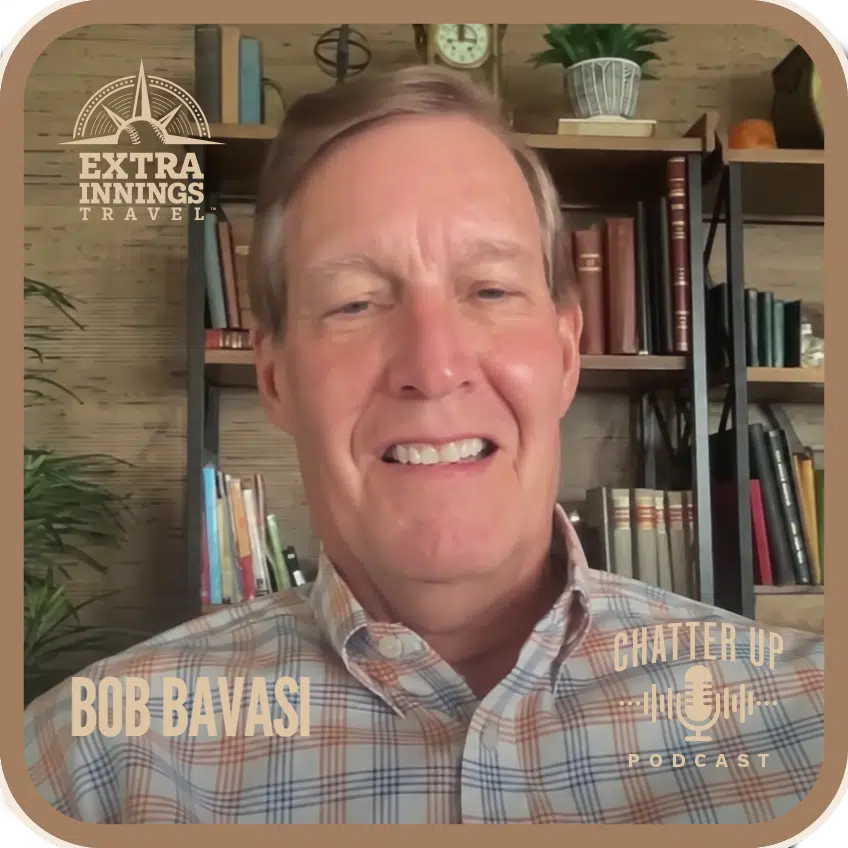
Chatter Up, presented by Extra Innings Travel, explores baseball’s international reach, the connections it creates, and the stories that make the game so special. Join Shane Barclay for conversations with amazing members of our global baseball community.
In our second episode, Shane is joined by JapanBall founder Bob Bavasi to trace the company’s origins. Bob reflects on growing up in one of baseball’s most prominent families, discovering Japanese baseball, launching the first JapanBall tours, and eventually passing the business on to Shane.
⚾ Extra Innings Travel: https://extrainningstravel.com/
⚾ JapanBall: https://japanball.com/
⚾ Bob Bavasi: https://www.bavasisports.com/
⚾ Musical Score: https://clarkbarclay.com
0:00 - Introducing Bob Bavasi
2:37 - Growing Up in a Baseball Family
6:37 - Discovering Japanese Baseball
14:28 - The Origins of JapanBall Tours
24:00 - Passing JapanBall to Shane
38:11 - Show and Tell
Chapter 1: Introducing Bob Bavasi
Welcome to Chatter Up presented by Extra Innings Travel. I am your host Shane Barklay and with me today is the one and
only Bob Bevesy. Bob, thank you for joining us. Well, thank you. Thanks for inviting me. You're welcome. Uh, I invited you. It's a little bit self-
serving because I'm new to this whole podcasting thing. I'm not fully comfortable talking to a mic or interviewing people, but I am very
comfortable talking to you. So, I appreciate you being a a safe space for me on this uh first interview we're doing on Chatter.
Yeah. Well, we'll see how we do. Yeah.
Yeah. So, it's not just about having a someone who's easy to talk to. Of course, the topic of conversation will be quite relevant today, too,
considering you were the founder of Japan Ball. Uh, which is the whole reason why we're here today, uh, because I took over Japan Ball from you and then
created Extra Eating Travel. And it's it's important, I think, for those listening and those part of our community or people who might come on our tours to know what we're all about.
And to know what we're all about, you got to know the origin story. And the origin story definitely starts with you.
Um, so if you wouldn't mind, we're gonna dive dive in a little bit and trace the the time until today.
Okay. All right.
So, for those who don't know, Bob is the son of Buzzy Bevesy. I think we have to start there. Considering Buzzy was the
patriarch of one of um what I consider a great modern baseball family that Bob is Bob is part of. And Buzzy ran the the
Dodgers, the Los Angeles Dodgers, worked for the Brooklyn Dodgers, ran the LA Dodgers for 17, 18 years, I believe, in the 50s and 60s. He won four World
Series. He was the founding president of the Padres's. He had a big influence on the beginning stages of the California
Angels and I should say definitely belongs in the Hall of Fame in my opinion. Well, nice to thank you.
So Buzzy has these wonderful sons, Bob being one, and his brother Bill was also a GM in
baseball and and his other brother Peter was also a very prominent baseball
executive. And so this baseball family gave birth to Japan Ball. So let's just start, I guess, briefly at least on what
Chapter 2: Growing Up in a Baseball Family
it was like growing up in the house of like a true baseball man and kind of being part of this whole baseball family.
Well, it was a lot of fun. It was kind of like growing up around the circus really, I think. You know, and and and for us, just going to the ballpark was, you know, it was just going to work with
dad and and uh so it was it and it wasn't until I got older that I realized that it was something special really. It
as a kid, it was just something you grow up with. But as we got older, we realized it was something special. And and for me, that was growing up in the
60s in LA when they had, you know, Buzzy had some terrific teams then. and then going on to San Diego where the teams
weren't so terrific and the crowds weren't nearly as big and it was it was hard getting the and I was in high school then and it was a wonderful time
to be to be in San Diego. I'm in high school and the ball club, you know, it was it was rough. I mean, they might
draw maybe 10,000 people a night. It was it was tough. And but as a kid, I got to participate in things like I asked my
dad one year, "Hey, can I can I design the uniforms?" Yeah, sure. Go ahead. And so I designed the uniforms one year and
they uh you can and I really think these it really should be in the running for one of the worst uniforms ever produced.
It was a mustard color and it's got to be around I don't know in the mid70s.
You can look it up. It's a mustard colored one. But the hat though, the hat still sells. It had like a triangle. It was a brown hat with a triangle of
yellow in there. But uh so anyway, it was a wonderful time to grow up around the game. And and then after college, as
my brother Peter said, we all graduated from college with two very important pieces to paper to get into baseball.
And it was our college diploma and our birth certificate. And so I was able to go to work for the San Diego Padres's
after that. And I did. And it was it was 1976.
And it was right after the arbitrator ruled in the Messer Smith McN arbitration that the reserve clause
which would bind a player in perpetuity to a club that was invalid and that then opened the door to free agency. And so I
worked in the minor league department there at the Padres's. But I recall agents and lawyers just walking down the hall and walking out with bags of money.
You know, it was just it it changed the game just like that. And I thought, I'm, you know, some, I think my future in the game would be to become a lawyer and and
I think they're going to need lawyers in the front office now. And so I did that.
I went to law school and then got out and I realized that going to law school doesn't make you a lawyer. So I practiced for a few years with the intent of getting back in the front
office. And then one day I saw a a picture in a photo on the cover of the
sporting news. And it was a guy named Larry Schmidto who had been a college coach at Vanderbilt University, the baseball coacher who had four baseball
caps sitting on his desk. And those were four teams that he was a part owner of that he had organized a lot of these country music guys to buy. And I was
astounded by that. What was astounding was he had these four teams that he was a part of and they were all making money. And that was kind of unheard of
in minor leagues in those days. And this was the the early 80s. And uh Margaret and I looked at that and we decided we
wanted to do that. And so we bought what was arguably the worst team in the country and uh the Wallawa Blue Mountain Bears. We got an affiliation with the
San Francisco Giants and moved it to Everett, Washington. And so we ran the minor league baseball team here for in Everett where I am now for about 20
years. And during that time I was appointed by the governor to a board of a local community college that had a relationship with Japan. And that's what
got me to Japan because we would go over, someone would go over and some member of the board of trustees would go over every once in a while, which
included me, on essentially a sales call to invite Japanese students to come to Everett during the summer when our
Chapter 3: Discovering Japanese Baseball
enrollment is low and give them sort of the American experience. And that's how I got to Japan.
Wow. Okay. Well, we fast forwarded through a lot. I'm going to back up a little bit there before Japan. So, how intentional? So, you your brother both
of your brothers a GM. I should mention Chris. Sorry to not mention Chris. Chris is the non- baseball brother.
He has an honest job, right? Yes. He's he's worked for the federal government for a long time. Yes, he is. Mayor Chris. Yeah, he was the mayor.
Shout out to him for, you know, choosing his own path. But at what point, how intentional was it for you to say, I want to be on the business side of
baseball, not the baseball operations side of baseball?
Well, you know, Sai Young could walk through the room here and I would have no idea. I, you know, I can go to a ball game with you and have a wonderful time,
but, you know, at the end of the game, you'll say, "Hey, do you remember when that short stop did the, you know, went there?" You know, I don't remember you.
I don't know. But, so for me growing up as a kid, what interested me were the concession stands and the souvenir stands. And what I I I narrowed it down
to call it the theater of the game. You know, I liked that part of it. I liked the entertainment part of it. I liked uh making sure that you had a good time at
the ball game. And so uh to to run a minor league team, it was perfect because I didn't have to worry about the players and what have you. Whereas Billy
and Peter, the brothers who are in the game that you speak about, they know players. They, you know, they they can put a club together. That just that's
just not my thing. My thing is being sure that you have a good time coming into the ball game and doing my best to attract you into the ball game. And sort
of my idols were guys like Bill Ve, you know, and people like that who were just, you know, crazy baseball operators. And those are the people that I thought were just, you know, fabulous.
And and that's who, you know, we tried to emulate here in Everett.
So then when you first went to Japan with the board of trustees, did you go to a baseball game then or when was your first Japanese baseball game? And having
said what you just did, what was your the impact on you?
Well, you know, it was so it uh so yeah, we we go to our first thing and and there were a lot of people from Everett on this particular trip and it was 1990
as I recall. And so the first place they take us is to a department store. Now, you know that department stores in Japan
are quite interesting. I mean, they are interesting and they're they're sort of fascinating, but but anyway, I'm dropped off. We're all dropped off at this
department store. I find my way to the sporting goods, you know, section. And there is Joe Copeland, who is the
editorial writer for the Herald here in Everett, Washington, the newspaper. He's on the trip. And I said, I said, "Hey, uh, you speak a little Spanish, Joe, or Spanish, uh, Japanese. Check this out.
Check there's a paper. See, is there a ball game here? We're in Nagoya." And sure enough, there was a spring training game in about a half hour. And that was
the ballpark in which uh, you know, Tom Celich, Mr. Baseball, that movie was filmed. So, we go downstairs and Mayumi,
who you know is who helped start Japan Ball, uh she is downstairs, you know, is the sort of the tour guide and Joe and I
are leaving. She says, "Where are you going? We're going to a ball game." "No, you can't do that. You can't No, you can't." Hey, so listen, we're leaving.
You'll never get in. And I thought to There's not a ballpark in the world I can't get into. We're going. So, we get there and uh sure enough, this spring
training game was was was packed. It was but I but we ended up getting seats and I sat on the on it was down third bay
side and I sat on the the seat uh that was closest to the aisle and Shane I kept getting up and down because people
were coming they were getting up to go eat and I thought my lord these Japanese eat a lot I got to that's amazing you
know the per capita spending here must be must insane because they're just always getting up and then I realized they were getting up to go eat they'd
come back, eat, and they would get up again and go throw their trash away.
Now, I found this. So, I said to Joe, I said, "Joe, I want to wait until the till the end of the game before we leave." He said, "No problem." I said, "But yeah, I want to wait till like
everyone's out. I want to see what this ballpark looks like." And they left.
Everybody left and this ballpark was immaculate. Now, in the United States, that would be a it would be a mess, right? because people generally throw
their trash on, you know, and uh so so that led me to think, gosh, there's got to be a way to do that. And you know, in the airplanes now where they come down
with the bags of of trash, well, they weren't doing that. Nobody was doing that. And uh I thought, gosh, there's got to be a way. And so, and long story
short, I hired this kid and dressed him up in a tuxedo, got a sponsor for him.
He was called Mr. Trash. And he would go around with a trash bag and he would solicit trash from people. And sure enough, people would put their trash and
pass it down the aisle. And we came close to having a Japanese clean ballpark at the end. I I I made a profit because we had everything spawn. I made
a profit on our trash pickup. And so for a minor league baseball operator, that is a big deal. And so I got that out of Japan. We got Mr. Trash. But what I got
what I really got was when I got there, I got just a real appreciation for Japan. I really liked it. I liked it a lot. And so so when I became chairman of
the board, we started doing some tours for local people. So I began to learn how to do tours and that kind of led.
So that was 1990 and you just alluded to doing these tours. But you're in are the Aqua the Aqua Are they the Aqua Socks by that point?
Yes. I think we did that in ' 80s.
No, no, I'm not sure they were. I'm not you know I can't I sort of forget 95.
Yeah. Okay. Yeah. So So no, we had No, we hadn't done that yet. And that came because, you know, the Mariners are right down the road from Ever. We're 30
miles from them. And but we were affiliated with the Giants, which was great. They were terrific. They were wonderful. But once everybody from the
Giants had gone somewhere else. I mean, it's baseball. Everybody sort of moves around. I felt like I could consider going with another club. And so, we went
with the Seattle's. And that was, as you say, 95. And so, that was when all the crazy logos were coming out. and we we
we we have a tree frog on the on the hat and it was and the lo frankly the it was a wonderful change in terms of the logo
and all that because Major League Baseball licenses those logos and the frog the still is one of the top selling
logos. It's really fun. Yeah, it appeals to kids. you know, when when we were trying to figure out the logo, we wanted to what you what they call
anthropomorphic, you know, we wanted to have arms and legs and, you know, and so so we came up with a tree frog and anyway, it's been cute and kids like it.
And I would love to ask more about that, but I will shout out I know a while back you did a a podcast interview with Baseball by Design. We talked a lot
about that. So, if anyone wants to know more about the Aqua Socks and their founding and Bob and Mart his wife Margaret's role in all that, listen to
the baseball by design episode, but we more want to talk about Japan. So, you're running the Everett Giants, I
guess, at that point. Like, so how did that transition go? I guess it was nine years between the first time going to Japan and then running the first formal
Japan ball tour. Uh, can you bridge that gap a little bit, please?
Yeah, so because I because we had a short season club and uh which starts in June is a rookie league. it was or
Northwest League short season at the time. And so I would start in June and so I had some time in April when they would do these trips. And so often I I
went to Japan more often than my other board members because I could I had the time to do it and so and they needed a slot filled and so I did it and the more
I got over there the more I thought you know people from Everett our community.
So when I became the board chair, I said to Mayumi, who was a professor at this college, I said, "Hey, listen. As long as we're going over there, why don't we
invite local people to come? You know, you can charge them." And uh you know, you make a little money for your program and you know, yada yada. And so we do
Chapter 4: The Origins of JapanBall Tours
and it was fun. And I found out I kind of like, you know, well, the first the first tour I asked the people I said, "Well, how what did you think?" They said, "You know, this was great. It was
fantastic, but it was a little too rugged, you know, that because we were always doing something. Well, that was Mayumi and her Japaneseeneseeness, you
know. You know, it's like we were running like a Japanese tour group, like, you know, boom, boom, boom, boom, boom. See, did get a picture here, next one, next. And it was real. And so I
said to Miami next year, I say, "Listen, I'll tell you what. I'll do I'll figure out what the itinerary will be." And so,
uh, so I figured out the itinerary. and uh and it included a ball game and people loved it and and these are people
who weren't baseball fans. They just liked the the insanity of it all because it is it's it's a Japanese baseball
game. I truly think you don't need to like baseball to go and have a good time there because it's just there's just so much frivolity going on for the whole
thing. You know, there's the cheering and you know, just sort of the spectacle of the whole thing. And uh so and then so so so then I got to know baseball. I
got to know some people there, some baseball people there and all that. So by the time I got So by the time I got done with the college which was right
around that would have been 10 years later. So you know 1990 so I was on for 10 years. So 19 the end of that year
around the I guess it was 1999 I decided that you know I really would like to go
and and I had since then I had picked up ideas from my own club including you know this Mr. Crash idea and others and I thought my fellow baseball operators
would like it. And so the first tour was with a bunch of baseball guys by you know minor league baseball up
and so of course that was a very specific group but eventually you transitioned to just bringing anyone
who's naturally be fans like what were you what were you hoping they would get out of that experience? I guess going
back to the operators as well, but and then the non-miner league operators and and I guess on the on the flip side, like what were you hoping to get out of it?
I wanted to go to Japan once a year.
Yeah, that's what I wanted. So, that's all I wanted out of this. I just I I like Japan. It was fun. Margaret and the kids
could go. Uh, you know, they wouldn't go during the tour, but they might come before, they might come after, you know.
So, that was honestly it. I just want to go to Japan once a year and have an excuse, a reason, you know, a reason for doing so. And So I remember the internet
was just sort of coming out and so I decided I was going to learn how to build the website and you know I had
some time I had so and I had sold the ball club so by now the ball I've sold the ball club and so so I've got time on my hands and I'm going to learn how to
do this website and I put a small ad every week in USA Today's USA Today's
Baseball Weekly. there was a weekly newspaper and that led people to the website and then you know away you go
and people signed up you know and paid money and off we went. I mean I was there was no one more surprised than I you know.
Were were there and this applies to writing the ball club or any of your endeavors but of course specifically the Japan ball. Were there any kind of
guiding principles or values or kind of a framework with which you decided to design your tours? Anything like that kind of that helped mold what it became?
Yeah, I think what Yeah. So the our our cultural attache as I called her was Mumi Smith and Miami was a Japanese
professor you know very recently at Ever Community College where this this college I'm talking about and so her she
her father was an officer in the Japanese Navy during World War II. He
was on the battleship Fusso which was sunk in the last battle of battleships ever. and he was one of the few who
survived this sinking. And he had moved the family out of Hiroshima into the hillsides, which a lot of people did.
They tried to get out of the cities. And so she Miami was not born yet, but uh her mother remembers seeing a beautiful
orange cloud and and that was the atomic bomb. And Mayumi was born sometime thereafter and
became very interested in the aftermath of the Hiroshima bombing. She lived there. She lived with these people and
so she had a great interest in that and that then and then she came to the United States to work and ended up getting married here and that led her to
want to have you know sort of an international connection with Japan. she felt it was like her duty to to spread
the gospel about Japan and and uh and and show that they were wonderful people and a good country and you know what have you. So she had this mission and
she calls it her mission and and I thought well this is perfect. This is a perfect way to do it using baseball to
help this mission that she has. She could care less about baseball. What she cared about was the mission. And uh and I just thought the baseball was a
perfect way of doing it. And I and I truly I do think it is because it's one of the few places where you can go and sit and the Japanese is, you know, may strike up a conversation with you.
Usually they're very, you know, they're nice people. I I find it just a wonderful country, but I I wouldn't say they're just, you know, truly gregarious or anything like that. And frankly,
Shane, one of the best times was one of these community tours we did while I was still on the board, and I wanted to take
them to a ball game, but I didn't have the tickets. And so I went and I bought tickets from scalpers out front, you know. So I had bunch of single tickets.
And so I said, "Listen, uh, these are all singles, you know, you're going to end up." And so everyone, and there's probably about 20 of them. They all went, they all they all went to the game
and they all were by themselves. And they all came back with these terrific stories, you know, of the Japanese people, you know, giving them food and,
you know, what have you. I mean, you know, all this because you you've been there. And so I think that, you know, our overriding thing is to we want to
try to show you Japan through baseball and not kill you by doing it. You know, we you know, the travel
I I really I I honestly think it's one of the best tours of Japan truly because you get to be with the people plus, you
know, you got the rest of the day or to see other things in Japan and we so we always have something going. It's a it's a it's a wonderful tour and I will say
this statistic you know we're in baseball so we care about statistics but it and what I found and I'm sure you're
is that fully a third of the people who come on our trips are repeat are repeat customers and these are people who not
one not one person ever said to me in all those years hey I've always wanted to go to Japan this has been on my
bucket list you know now I'm getting to do it I'm So great. Not one. So none of those people came to Japan is is is that
was their their thing. They came because they wanted to see some baseball and they fell in love with it. And and that I think is the best advertisement we
could have is that the repeat business, people coming back and because I thought it'd be something you do once in your lifetime.
Yeah. Yes. I agree. I I'll say that in the last six years or so that there are a lot of people people want to go to
Japan now, which is now. That's right.
Which is great. I'm glad to be in that business. Yes.
But it's it's Well, I guess that's a good way just to to tie it together then. So, you had
been running this self- sustaining thing. You got guests coming every year.
You're running the website. And then in 2018, your brother Bill introduced us. I
asked him for an introduction because I was curious about getting into the baseball tourism business as well. So
where where were you at with the company at that point? Just to kind of I'm I'm in hindsight, I kind of know the answer,
but I am kind of curious, you know, cuz you know, you were just getting to know each other and I don't think you're fully revealing your cards at the time.
So, can you contextualize that that era, 2018, 2019, please?
Yeah, I you know, I I'd gotten to the point where I knew what was around every corner. You know, I I knew I' I'd taken
groups to places. every place I wanted to go to, I'd been after the tour, before the tour. I, you know, my the kids and I, we Margaret, we do bike
rides or boat trips or I mean, we so I and so I sort of the movie Forest Gump where he start, you know, he takes off
running. He's just running and uh and then one day he just says he stops, you know, and and I was at the the Hunchen
Tigers game in Osaka with the group. It was probably, you know, the fourth game of five games of the trip. And, you
know, I'd done this now many years. And I thought to myself, I've I've seen it all. I did it. I've done, you know, and then I remember coming home and calling
Billy and and my brother and just saying, you know, I think I'm I think I'm going to look for somebody to turn this over to. And he said, "Well, hold
on." He said, "They had just had a going away party for you." He, he told my brother Peter this story the other day.
Chapter 5: Passing JapanBall to Shane
I guess you know Kim said, "Hey, we're having a going away party for Shane and Billy came and you know, you were
chatting and one thing led to another." So So yeah, I you know, you and I that was just real serendipity for the both of us. Yeah.
And and and for you, you know, I always thought that someone could someone who has more ambition than just wanting to
go to Japan once a year could really take this and do something with it. And that's what I'm watching now. I'm watching you do that and it's it's fun
to watch. I and you I'm delighted to be a part of it and to have been a part of Yes.
The feelings mutual. Yeah, that was incredibly fortuitous timing and I'm very grateful that I did not have to start a business from scratch and I got
to skip the hard part which is building up that community. And uh I I told everyone in the beginning and it still
is true today like the most important thing in in taking over Japan ball was to to not mess up a good thing and
it's you know there's lots of people who have been and we have people have been on your trips you know over a dozen times and have continued with me today
and that's my goal and then slowly build it up of course.
Yeah. and you're and you've got the family involved which I think is terrific and you know it and and that points out that I mean you're taking a
much more broad group of people to Japan or well and not just Japan but to these other countries, you know, the Dominican, the Netherlands and what have
you. you know, you've really expanded it not only in terms of the offering, but the the market or the market that you
can appeal to and and I'm and having your family involved in that I just I think's really terrific and it it's
showing. I mean, you know, you're you're blowing the doors off. You're doing great.
Thanks. Yeah. I mean, you I know that you you said it yourself like you wanted to be able to bring the kids and Margaret and and you did and that was part of my vision as well.
And the fact that you did that gave me comfort in embarking on this because that was always part of my vision. I mean, Jesse and I love to travel and we
want to be able to have the flexibility to do things on our own time and bring the kids like all, you know, we just did our first trip to Netherlands with all four of us and it wasn't all easy. It
was a little bit trying, but it was amazing when we had because it was what the vision was happening. And uh you
know, a couple years ago, we brought Brooks on all over the world. He's got like a full passport already. So, I appreciate all of our guests being patient with that cuz I do I'm bringing
them like on the tour and and so far all of our, you know, every time we start a tour, I say like, "Hey, we're family now. We're going to look
out for each other. You may not know yet, but by the time we leave, we're all going to feel like family." And Yeah, I really am grateful that a lot of our guests have embraced that concept.
Well, but but but it's because you have said it and it's a it's great and it's terrific and uh and it it makes it's
it's it's you know the it it makes the group cohesive. But the other thing that I think is interesting about these tours is that people some people have come on
the tour say you know I never do group tours. I don't like group tours. I don't want to go on a group tour. You know you know and and you're probably a traveler like that yourself. you know, we and but
when they come or if I have the opportunity to talk to them, we have a schedule that we're, you know, we're going from trying to, you know, the ball, we have a schedule. We're going to
the ball games and but we we teach you enough about Japan that you can go off on your own and come back and meet us,
you know, as we go. And so I what what I really enjoyed are people who they want to go see something on their own. We
help them do that and they come back and join the group as we're as we're progressing on. I So I that the other thing I I thought was great about our
tours is that the freedom the freedom you have, you know, no one's no one's not only the freedom that you have and knowing that you will be safe. We know
that you will be safe because it's Japan and it's safe and uh and all they need is a hotel card. You could drop someone
anywhere in Japan with a card with an address on it and that person will get back because there will be people who
help them back. And that that's is one wonderful thing I enjoyed about Japan was it's it's clean, it's safe and it's
orderly. It it it just works. Japan works, you know. So I
Yes, agree 100%. I think I what you're saying about the the guests going off on their own. I mean it's so and especially nowadays of course it's even easier with
you know with our phones but I love it when our guests are like we you know we have our group chat now and they put in the chat like hey I'm going to go here
who wants to join me and having that freedom but then also letting people kind of figure things out and have that
true experience of of you know touring on their own because like you I mean the fact that I'm a trip planner I think is indicative of like you said I wouldn't
be the one to sign up for a group tour normally And I think a lot of our guests are like that. A lot of our guests go on their own baseball tours domestically and you know they love planning them.
But going to going abroad is a little bit more intimidating or harder to figure out or not sure about tickets or you know in some cases maybe they just
don't want to plan it. But one way or another it's usually that they come on our trip because they need help with the logistics of actually making it happen.
And then on the trip they kind of figure it out like they start to get the the hang of it. Now we have um you know these transit cards. We don't have even have to buy tickets or anything anymore.
So the guests really feel empowered to figure it out. And inevitably a number of guests do come back on their own.
Actually we have a guest right now who's sending us pictures to the old group chat from before saying he's at the NPB Allstar game and he's doing all sort and
you know so it's great. I'm happy he's doing it. But so many of our guests still come back on our tours and because
they come for the logistics and they come back for the people because like I always say I I'm more more along the
lines of am I at a game. You said you don't easy to notice what the shortstop did. I am more of a baseball purist in that sense. Like I noticed what the shorts stop did and I I have everyone I
always say everyone has a neighbor or an uncle that they can talk baseball with or you know or an aunt or rel they have that one person in their life they can go deep
with on baseball and like not tire of it. And now on our tours, you're going on a trip with that person times 12 or 15.
And it's like, oh, I can do like baseball trivia or reminisce about the 72 Dodgers or, you know, talk about that
obscure, you know, no hitter and and no one you just can't get enough of it because it's it's like a kid in a candy
store of like I get to see this new country and do these cool baseball experiences, but I get to do it with people who are just like me
and they're nice, aren't they? That's the thing. I just I can't get over it.
They're baseball fans are just just nice people. I mean, you really it's it's and I always found it remarkable how how the
group gels just so quickly. And I guess it's because, you know, everybody likes baseball. I mean, they have a common interest, you know, but but that doesn't
mean they necessarily need to be nice, but they are. They're it's just it was it it was so pleasant. I I always I just loved it. I just thought it was great.
But I think I'd seen enough. I think there's an element first of all of like baseball just the the nature of baseball
and what type of people it draws like there I think it there you can draw some conclusions about like if baseball was
your chosen sport or passion you know that there's certain things that draw people to the game but I also think a big part of that I always
think about my parents who owned an ice cream shop and they said it was the best job ever because everyone came into their place of work with a huge smile on
their face and they're so happy to be there. And so I feel like that's the case with my job where our customers like their happy place is the ballpark
and that's my work of my place of work and I'm bringing them to the ballpark and they all couldn't be happier. You know, I think a lot of people come on our tours all their problems go away
when they're sitting there in the ballpark watching a game.
Yeah. It's a nice feeling. Yeah. No, it's it's a great feeling to be able to do that. Yes.
And you're doing you're doing what a true baseball operator does, Shane. You're putting butts in the seats.
That's what this that's what baseball is all about.
I'm I'm working on it. Yeah. So, I think that pretty much brings, you know, brings us to the present day more or
less of when, you know, I took over. I think we don't have to go into all the details, but it was a match made in heaven and a fortuitous one. And despite
the fact uh you had the little hiccup of us signing the paperwork on January 1st, 2020 and then a global pandemic hitting
imminently after that, it's all gone exceptionally well. And I'm very grateful for the role you first of all for the
groundwork you laid and for the trust you put in me. And uh it's cool hearing about your motivations because a lot of
them are the same. And of course I've made it into something a little bit bigger than just I want to go to Japan every year. that that principle is very
much mine too, right? Like when I left Major League Baseball, I was like, "Okay, what are my favorite things about my job? I want to travel the world
through a baseball lens." And and that's what I've been able to do.
And I would like to think I would have figured it out because I was interested in kind of this general concept, but I'm not sure that I would have. And you
definitely did figure it out. And I appreciate you kind of putting it on a platter for me and I'm I'm grateful for the role you've played since then and
leading up to and and and during the transition as well.
Well, yeah, it's been my pleasure. No, it's been as you as I said it's we've been lucky. I mean it's been it's been nice serendipity and and that's what I
was hoping for someone who might grow it you know someone who you know might might do what you're doing and and then
and then so the fact that it is growing internationally in terms of where you're going but also the different type of
people you know you've got kids coming now and teams and all that so that's and and so the logist and so you know hence
you have you know you've got more people working for you you've got people in all these these countries now. I mean, it it's it's quite remarkable really how
how this is, you know, the the the the Dominican and the the not well, not only that, but you've got some domestic tours
going too. You've come up here Northwest before. You've done the up to the game of the Midnight Sun in Alaska. You know, if you're a baseball fan, Shane
Barkley's the guy to travel with right now, I think. I mean, I mean, you're you're hitting all the spots, right? I mean, you are. And the other thing is
unsaid here is that you were with Major League Baseball International. So your job was to go around the world. I mean
that was your job. And so so you know people that's the other thing that you know people in these various countries and so that the uh the fans that go get
more than just going to the ball game particularly in the Dominican where you're where you're real where you're you're big in the Dominican.
Yeah. Well, I appreciate that. I think the fact that I'm blushing the the fact that I'm blushing now means it maybe this is a perfect wrapping point at this
point of you know I think you brought us there. So there we go.
Yeah. I mean yeah again I'm grateful for you talking about it and and catching our readers up. I I learned a few things there too as well. So all right well now
that we've discussed the origins of of Japan ball and and that's evolution into extra innings travel. I'd like to transition to our show and tell segment.
The show and tell segment is uh just something a little fun that I thought would help further reveal a little bit
more about what we're about and and like what we believe in. So, I gave Bob a prompt. I said, "Can you please bring an item to show and tell that exhibits or
de exemplifies one of, if not more of the following things, which is demonstrates the global nature of
baseball, demonstrates the unifying powers of baseball, or it's just otherwise nostalgic in some way." So, Bob, I'm going to ask you to share.
Then, I brought an item, too. And uh we'll do this every episode as a way also for me to justify having all the
stuff I have in my house. I if I share it with someone at least, you know, it's not just sitting there taking up space.
And you know, maybe Jesse will be more supportive of all my baseball momentos.
So there you go. All right. So go ahead, Bob.
All right. Well, this what I this what I one of actually three of our guests, Stacy and Greg and Allan, who were from
the United Kingdom. They're from England and they gave me a cricket bat or you see that a cricket bat and then it's got
the logo on it or anyway and saying you know thanks for a great tour and that was done in 2009.
That's cool.
And these three people by the way are in the Japan Ball Hall of Fame. Nice.
Because they had uh they went and saw it all. They did all the, you know, we the trip was for five or six games, but they went to see every one of them. And so by
doing that, you get into the Hall of Fame, which is in a noodle shop in Tokyo on the wall. Sure is.
And and now our the wall is getting filled up. And thankfully Jude and Coco are still very graciously allowing us to
keep adding another space. We're going to have to take that space over next door, I think.
Yeah, exactly. Well, yeah, that's awesome. Thank you for sharing that. Did they send that to you afterwards or did they bring that thing with them?
No, they sent you I got in the mail. Yeah, they sent it to me.
That's really cool. And where do you have it now?
I have a sort of display case, you know, balls and you know, things that I've collected, you know, over the time that means something to me. And and this is
representative of people from Japan ball. Yeah, that's it's there to remind me of. Cool. Well, hopefully they watch this one.
We'll have to send it to them specifically, but that's I'm sure they'll be flattered that you still have it. All right, here's my item. I just I love old
Chapter 6: Show and Tell
school classic baseball photos. I think players are a little bit too pretentious to take classic photos like they used to, but I thought this could prompt
maybe some thoughts for you. This is Can you tell who that is? For sure.
Yeah, my Wills. So, I just love these like old school baseball photos.
Yeah. Yeah. Speaking of could be Hall of Famers along with your dad, I think my Wills is in that category, but he's not in Coopertown. But does that um I don't
know. Do you have any does that prompt any memories or thoughts or anything about Oh, yeah. your dad.
Well, that was just uh you know, that was right in my wheelhouse when I was a kid. Mory will stealing the bases. you know, the big deal with the Giants where
they'd they when he'd go there, they'd they'd water down the base path so he couldn't get going, you know, and and he just brutalized himself stealing all
those bases. I think he stole 102 if I'm not mistaken in 1962 or three. And quite the player and
yeah, but nothing in particular. I don't have any, you know, stories about him except except he was sure fun to watch. Do you did
your dad take the the team to Japan or did he ever go to He did not. He when they went to Japan,
mom and dad had never got on a vacation really, you know. And uh it was their 25th anniversary. He had they had gotten
married 25th in Americas, Georgia where his first posting was for the Dodgers and he
was running the club there. And so mom came down to get they were they were going to wait till the end of the season but ended up getting married there and his his manager was his best man and his
manager got thrown out of the game that afternoon but it was all you know pretty much and I uh anyway I'm not sure where I was going with that but I was asking about if he took him to Japan.
Thank you. So uh thank you. So anyway it was their anniversary. It was that was their anniversary when they were going to Japan and they had booked a cruise to
Hawaii and so they decided to take it you know. So he did not go to Japan. Got it.
On that trip and and to my knowledge never went to Japan actually. Yeah.
Although he had plenty of dealings with some of the Japanese guys particularly Cappy Harata who was a name that you might know. He was a you know sort of a
scout and supplied some players. But um but was interesting you know I asked dad one time years ago. I said aren't there more Japanese players? He said they're
just they're just not big enough you know they don't have the the strength.
And and I kind of saw that cuz in 1990 when I first went to Japan, I'm 6'1 I guess on a good day. I tower over everybody in the subway. Just towered.
Now if I go to Japan, I am they're big. They're big. They've got bigger.
It's and it's remarkable in just that, you know, relatively short period of time how much bigger, stronger they are.
And and you're seeing it in the big leagues.
Yes. I think there's one individual who certainly uh demonstrates that.
And that individual, Shi Otani, I'm very grateful for because he's the best best marketer there is for Japanese baseball.
And and tour and you know, you mentioned it earlier, tourism there when I started this was Japan did not register on
the tourism, but now it's just, you know, it's it's off the charts. Yes. Yeah. People want to go. Yeah.
All right. Well, thank you for uh bringing that show and tell item. That was really cool. And uh and thank you again for joining us. This was really
fun and I think I accomplished my goal of having a easy guest to start off with. Thank you for being that person and
and uh and I'm glad it aligned with kind of the timeline and laying the groundwork for for what's to come on this podcast.
Yeah. Well, I'm I'm thank you for asking. I'm grateful to be a part of what you're doing and and more power to you. There you go.
Thanks, Bob. Take care.